Crime at Sea: Are Cruise Ships Actually Dangerous?
Cruise ship crimes make irresistible headlines. Federal data tells a considerably less frightening story—and complicates Carnival’s reputation as the industry’s troublemaker.
There may be no vacation setting more carefully engineered to feel safe than a Disney cruise.
And yet, this spring, passengers in San Diego watched crew members being escorted from cruise ships by federal authorities during an investigation involving child sexual abuse material. U.S. Customs and Border Protection inspected eight ships and detained 28 people. The agency revoked the visas of 27 individuals—most of them cruise workers—and Disney said it terminated employees involved. No passengers were identified as victims.
It was disturbing. It was also almost perfectly designed for a headline.
Crime at sea has a theatricality the same crime on land does not. A brawl at a hotel is a brawl. A brawl on the Lido deck is a cruise ship brawl. And when Carnival’s logo appears in the background, the internet practically writes the story itself.
But the available evidence suggests something less sensational: serious crime does happen at sea, yet cruise ships remain remarkably safe considering the millions of people who vacation aboard them each year.
What the Federal Numbers Show
Under the Cruise Vessel Security and Safety Act, covered cruise lines must report specified serious criminal allegations to the FBI. The U.S. Department of Transportation publishes those figures quarterly, including allegations of homicide, suspicious death, kidnapping, serious assault, sexual assault and theft of more than $10,000.
The crucial word is allegations. The reports are not a tally of convictions, or even necessarily of crimes ultimately determined to have occurred. They also exclude many lesser incidents. Still, they provide a public cruise-line-by-cruise-line accounting that has no obvious equivalent for hotel chains, resorts or theme parks.
Cruise ships may sometimes look more dangerous precisely because their serious incidents are so visible.
The Carnival Myth
Carnival is more closely associated with onboard misbehavior than any other cruise brand. Viral fight videos, affordable fares, short itineraries and a famously festive atmosphere have created a caricature of Carnival as the place where civilization occasionally takes the week off.
But federal data does not support the simple claim that Carnival is uniquely dangerous. In late 2025, Royal Caribbean—not Carnival—recorded the highest raw number of reported serious incidents. Published analyses of early 2026 data again put Royal Caribbean ahead of Carnival.
That does not mean Royal Caribbean is unsafe. Raw counts ignore passenger volume, fleet capacity, cruise length and time spent aboard. They are a poor basis for ranking cruise lines. The more useful conclusion is that federal numbers do not neatly conform to the reputations we have assigned the brands.
A fight aboard Carnival confirms a narrative. The same incident aboard a premium or family-oriented line feels aberrational. That is branding at work—not criminology.
Safer Than Land—with an Asterisk
Research commissioned by Cruise Lines International Association found far lower rates of homicide, aggravated assault and sexual assault aboard ships than in the U.S. cities used for comparison. For 2015 through 2018, it calculated an average aggravated-assault rate of roughly 2.6 incidents per 100,000 cruise passengers and crew, compared with 432.2 per 100,000 in the comparison cities.
That gap is extraordinary. It also deserves an asterisk approximately the size of Icon of the Seas. The study was commissioned by the industry’s trade association, used selected cities rather than the entire United States and compared temporary vacation populations with permanent urban populations.
The responsible conclusion is not that cruising is precisely 166 times safer. It is that nothing in the available data supports the popular image of cruise ships as unusually crime-ridden places.
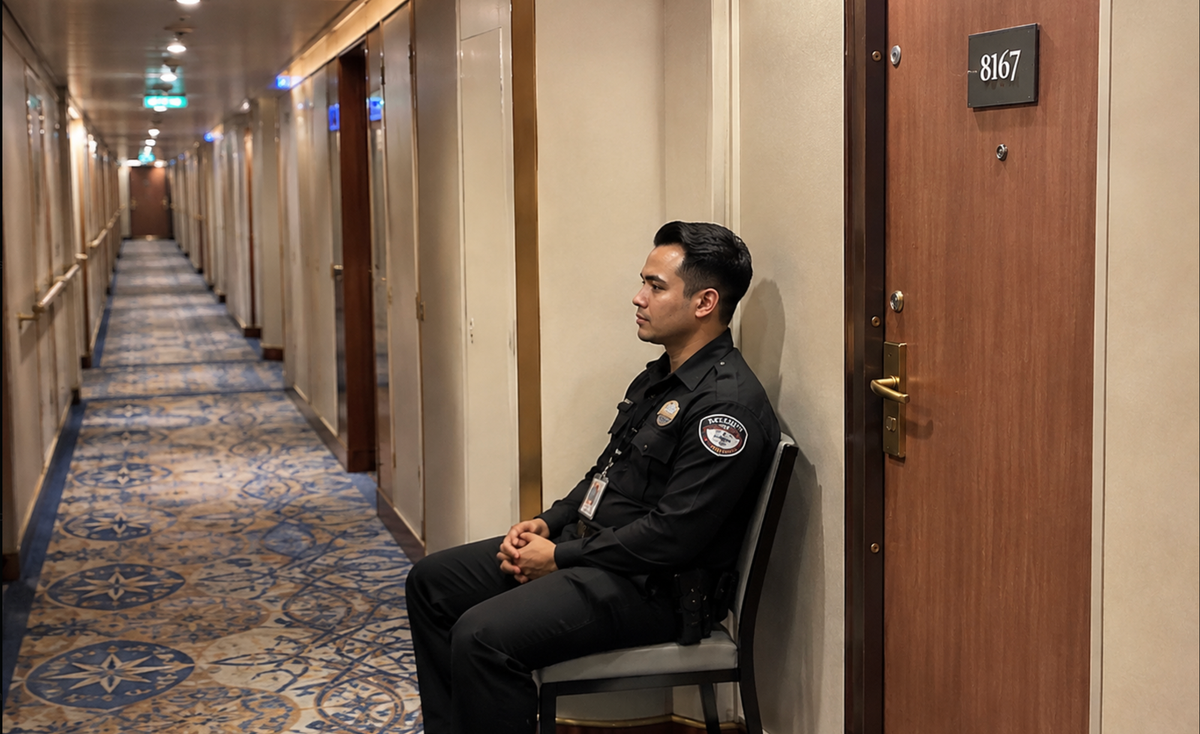
There are plausible reasons. Passengers present identification before boarding. Access is controlled. Security officers and extensive surveillance are present. Cruise lines know who is aboard, and a potential suspect cannot discreetly leave the neighborhood.
A ship resembles a small city with an unusually controlled border. That does not make it crime-proof, but it may help explain why serious incidents remain relatively uncommon.
Safe Does Not Mean Risk-Free
One category should not be waved away with reassuring statistics: sexual assault. It consistently represents a substantial share of serious allegations in federal cruise reports, and the FBI has identified alcohol as a recurring factor in sexual and physical assault cases aboard ships.
Cruises combine unfamiliar surroundings, lowered inhibitions, abundant alcohol and thousands of strangers in close proximity. Sexual assault is also notoriously underreported on land and at sea, making comparisons especially difficult.
Passengers should not interpret “cruise ships are generally safe” as “nothing bad can happen here.” Keep track of drinks, lock the cabin door and remember that a family-vacation environment is still populated by strangers. The ocean does not create a force field.
Cruise lines, meanwhile, must prevent incidents where possible, preserve evidence, support victims and cooperate with law enforcement. Crimes at sea can involve complicated jurisdiction and witnesses who scatter around the world after disembarkation.
Still, tens of millions of people cruise each year—sleeping, drinking, dancing, arguing and occasionally committing crimes in densely populated floating resorts. Considering that human experiment, the surprising story may not be how much crime occurs aboard cruise ships.
It is how little does.
SOURCES: U.S. Department of Transportation Cruise Line Incident Reports; Federal Bureau of Investigation; Cruise Lines International Association; Associated Press.